Why every Indian AI startup is building a voice agent
31 voice AI companies in India, ~$449M raised, and one company holds 78% of it. The reason everyone piles into voice is not the 22 languages. It is that voice is the only AI product sold into a budget line that already has a price per minute.
Count the Indian voice AI startups and you get 31, per Tracxn's July 2026 tally. Twenty are funded. Seven are at Series A or beyond. One is a unicorn. Cumulative sector funding is around $449M, of which Sarvam accounts for roughly $350M.
Do the subtraction. Every other funded voice AI company in India is operating out of a combined pot of about $99 million. That is one decent US Series B, split nineteen ways.
And Sarvam is not really a voice company. It is a general-purpose Indic foundation-model lab: Sarvam-30B and Sarvam-105B are open-weight LLMs, and the speech stack is one line of business inside a company that also holds the government's sovereign-model mandate. The fact that a tracker has to file that company under "voice AI" for the sector's headline number to look large is not a footnote. It is most of the story.
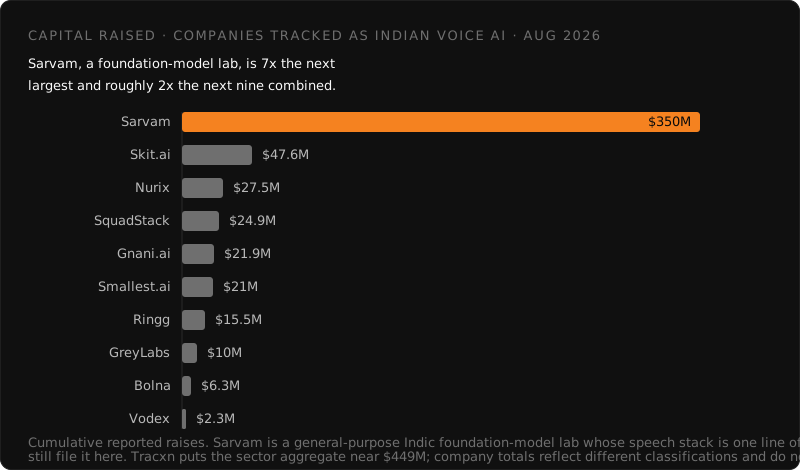
One bar is the sector. Cumulative reported raises, August 2026.
I keep getting asked about this from Rome, mostly by European founders who see the Indian deal flow and assume they are missing something structural. They are, but not the thing they think.
Here is the same field as a table, with what each company actually sells:
| Company | Raised | Latest round | What it sells | Reported scale |
|---|---|---|---|---|
| Sarvam | ~$350M | $234M first close of a $300M Series B at $1.5B, Jun 2026, HCLTech leading | Indic foundation and speech models | 2M+ interactions/day, 500k+ audio hours transcribed/month |
| Skit.ai | $47.6M | $23M Series B (2021) | US debt-collections voice AI | 120+ collection teams |
| Nurix | $27.5M | Series A, Accel + General Catalyst | Custom voice and chat agents | acquired Verloop.io in 2026 |
| SquadStack | $24.9M | Series B, Aug 2025 | Outcome-priced calling, human plus AI | picks the AI/human mix itself |
| Gnani.ai | $21.9M | $10M, Aavishkaar Capital | Voice-first CX, BFSI and telecom | 30M+ spoken interactions/day, 200+ enterprises |
| Smallest.ai | $21M+ | $13M Series A, Jul 2026, Seligman | Small fast voice models | customers include RingCentral, Truecaller |
| Ringg | $15.5M | $10M Series A extension, Peak XV, Aug 2026 | Voice plus omnichannel automation | 20M call attempts/month |
| GreyLabs | ~$10M | ₹85 crore Series A, Elevation + Z47 | BFSI call QA and compliance | - |
| Bolna | $6.3M | Seed, General Catalyst + YC | Self-serve voice agent platform | 1.5k to 200k+ calls/day since May 2025 |
| Vodex | $2.32M | Seed | Outbound collections voice | - |
Scale figures are company-reported. Add Krutrim, Navana, Cekura, CoRover, Jio Haptik and a long tail of wrappers, plus Ozonetel and Exotel already holding the telephony contracts.
Three honest caveats before anyone quotes the arithmetic at me. First, the rounds named above sum to more than the ~$99M the sector aggregate implies, because "voice AI company in India" is a tracker's judgement call: Skit.ai has been a US collections company for five years, SquadStack started as a human calling operation, and different trackers file them differently. Second, Sarvam's ~$350M counts a $300M Series B of which $234M has actually closed. Third, and most importantly, Sarvam belongs in a different category altogether, as above. The directional point survives all three: outside one foundation-model lab, this entire sector is running on seed to Series A money.
The reason everyone gives, and why it is only half right
The standard answer is linguistic: 22 scheduled languages, hundreds of dialects, 870 million people using the internet in an Indic language, English spoken by only 10 to 12 percent. Voice is how India actually transacts. About 40 percent of rural users rely on voice search because typing Devanagari or Tamil on a QWERTY keyboard is genuinely painful, and Truecaller's research says 76 percent of Indian consumers would rather phone a business than message it.
All true. All insufficient. Those languages have been spoken here for centuries, and the same argument was fully available in 2016, when it produced Vernacular.ai and Gnani rather than thirty companies. A condition that has held for generations cannot explain something that happened in the last three years. It explains the size of the prize, not the timing of the rush.
The reason that actually explains the timing
Voice agents are the only AI product in India that gets sold into a budget line that already exists, already has a unit price, and already has a manager whose bonus depends on shrinking it.
India's contact centre workforce is about 1.6 million people. Voice outsourcing goes for $6 to $14 an hour. The average agent costs roughly ₹4.4 lakh a year. Bengaluru alone seats over 200,000 agents. Every one of those seats is a metered, forecast, line-item cost that somebody already owns.
So the pitch is not "imagine what AI could do for you." It is "you pay ₹6 to ₹7 a minute for this today; I will do it for ₹2.5." At a million minutes a month that is ₹35 to ₹45 lakh of savings, and the buyer can verify the claim from their own invoices before the pilot ends.
Compare that with selling an enterprise RAG deployment, which is most of my working life. I have to establish that the problem exists, that it is expensive, that the expense is measurable, and only then that we can reduce it. Four arguments before the price conversation. A voice agent skips the first three. That, and not the language count, is why every seed deck in Bengaluru is a voice agent: it is the shortest path from demo to a number a CFO recognises.
The 22 languages are the reason India can win at this. The per-minute budget line is the reason everyone is trying right now.
Three things here are genuinely defensible
Code-switched telephony audio is a real moat. Code-switching pushes word error rates up 30 to 50 percent relative to monolingual speech, and over 250 million Indians code-switch as a default register. On noisy Hindi-English telephony audio, global models land around 14 to 16 percent WER, leading Indic models 11 to 14 percent, and Gnani claims 9 percent on its own audio profile. Vendor numbers, so discount them, but the direction is right and it matters: that training data is not on the public internet. It is sitting inside Indian call centres, and whoever holds it holds something OpenAI cannot buy off the shelf.
I have paid for this lesson at small scale. Building Pravachak across seven Indic languages plus English, the thing that broke was never the model's reasoning. It was romanised Hinglish input, mid-sentence script switches, and per-language quality variance that my averaged eval scores were hiding. I wrote that up separately. Voice makes every one of those problems harder, because you lose the option of asking the user to retype.
The state is a distribution channel. IndiaAI Mission is renting roughly 34,000 GPUs at ₹115 to 150 per GPU-hour, about 42 percent under market, targeting 100,000 by year end. Sarvam took 4,096 H100s and the sovereign model mandate; Gnani took the voice foundation model mandate and is shipping voice-to-voice in six languages with a stated path to all 22. Sarvam's multilingual agents were used to collect data from 17 million farmers for the Ministry of Agriculture. There is no European equivalent of that, and I say that as someone who spends his week arguing for sovereign AI inside the EU. India converted a policy position into subsidised compute and a first customer. We mostly converted ours into a tender that resolves in 2028.
Rupee cost base, dollar revenue. The cleanest version is Skit.ai. Founded as Vernacular.ai in 2016, built Indic voice bots on ten million hours of speech, then aimed the entire company at US debt collections, where it now serves 120-plus collection teams under FDCPA. India taught them how to build it; America paid for it. Ringg, Nurix and Smallest all run some version of this. It is not a betrayal of the local market, it is the only way the unit economics clear.
Four reasons it still looks like a bubble
The money is one company. $99M across nineteen funded companies is seed-scale capital for a category that requires enterprise sales motions, telephony integrations and 18-month procurement cycles. Most of these companies cannot afford to lose a deal.
The price floor is arriving faster than the differentiation. Sourced independently, the components cost $0.05 to $0.15 a minute: STT $0.004 to $0.024, LLM $0.003 to $0.08, TTS $0.02 to $0.10, telephony $0.008 to $0.014. Real production deployments land at $0.12 to $0.25. Managed platforms charge $0.25 to $0.50 all-in, and the fattest line in that stack is the orchestration fee, which is exactly the layer most of these startups sell. When your revenue line is someone else's commoditising cost line, you are on a clock.
Pilots do not convert. IDC puts 88 percent of AI agent pilots as never reaching production. Gartner's January 2026 update has GenAI project failure above 50 percent. S&P Global found 42 percent of companies abandoned most AI initiatives in 2025, up from 17 percent the year before. Voice has a wider demo-to-production gap than text, because the demo happens over a clean laptop mic and production happens over a 2G-era mobile connection in a market with a scooter going past.
The regulator is actively hostile to the core use case. India is the fifth most spam-affected country in the world, 66 percent spam intensity, with sales and telemarketing at 36 percent of it. Airtel alone has flagged 71 billion calls as spam since 2024.
What is already in force: the Telecommunications Act 2023 requires prior consent for commercial messages; TCCCPR as amended in February 2025 requires DLT registration of entity, headers and templates, confines promotional calls to the 140 series and transactional calls to the 1600 series, bars ordinary ten-digit numbers for telemarketing, caps transactional consent at seven days, blocks re-solicitation for ninety days after an opt-out, and escalates to suspension of a sender's telecom resources then blacklisting. RBI holds lenders liable for outsourced collections agents and confines calls to 8am-7pm at two or three attempts a day across all channels. IRDAI moved insurers onto the 1600 series in February. Since 20 February 2026, AI-cloned voice is "synthetically generated information" under the IT Rules and needs disclosure and permanent provenance metadata. DPDP's substantive obligations land in May 2027, with penalties to ₹250 crore.
What is not in force, whatever the compliance blogs tell you: per-call AI disclosure and consent-verification for AI telemarketing sit in TRAI's draft Third Amendment, out for consultation on 13 March 2026 and not yet notified. The Digital Consent Acquisition registry exists on paper and never got adoption, so there is no national consent database to query before you dial. And the widely quoted ₹2 lakh / ₹5 lakh / ₹10 lakh graded penalties fall on the access providers, not on the sender.
Read all of that as a product spec rather than a compliance annoyance. That is the moat, and the half that is still draft is the half worth building before you are forced to.
The honest objection: today almost nobody complies
Everything above describes the rules. It does not describe the market.
In practice a large share of outbound calling in India is not run by the enterprise whose brand is on the call. It is run by small third-party agencies, and much of that runs on ordinary ten-digit SIMs rather than the 140 or 1600 series, because a call from a mobile number gets answered and a call from a recognisable telemarketing range does not. Vendors selling SIM-based dialers advertise roughly 2.3 times the connect rate of compliant cloud telephony, and that single number explains the entire grey channel. Compliance does not just cost money here. It costs you the answer rate, which is the only metric the agency is paid on.
TRAI is not passive about this. More than 800 entities have been blacklisted and over 1.8 million numbers and telecom resources disconnected; a first violation draws a 15-day suspension of outgoing service and repeat offenders can be cut off across every operator for a year; as few as five complaints in ten days can trigger action; and the regulator has levied penalties reported at ₹150 crore on the operators for failing to contain it. But the supply regenerates, because a disconnected SIM costs almost nothing to replace and the agency has no brand to lose.
So when I say the compliance layer is the moat, the fair objection is that the market is currently rewarding the opposite.
Why AI agents close that gap rather than widen it
The intuitive read is that AI makes the grey channel worse: cheaper calls, more of them, same unregistered SIMs. I think it breaks the model instead, for three reasons.
Scale is a signature. A human on a SIM makes a few dozen conversations a day. An agent makes thousands, with machine-regular pacing, duration distributions and answer-rate patterns. The core of TRAI's draft Third Amendment is exactly this: mandatory AI and ML detection at the access-provider layer, doing pattern analysis on volumes, call durations and recipient behaviour. Human-scale evasion hides in the noise. Agent-scale evasion is the signal.
The liability chain no longer has a gap to hide in. The buyers worth having are already unable to outsource responsibility: RBI holds the lender liable for its recovery agent's conduct, and from January 2027 IRDAI requires the individual who sold a policy to be named on the policy itself. "A vendor's team was dialling from their own phones" was never a real defence, but it was an available story. When the caller is a system you commissioned, configured and pay per minute for, it stops being available.
An agent is auditable by construction. A person on a personal SIM leaves no artefact: no recording, no transcript, no consent reference, no timestamp. An AI deployment leaves all of it whether you want it or not. That is a liability if you are cutting corners and an asset if you are not, and it is the reason the compliant architecture and the defensible architecture are the same architecture.
Put those together and the 2.3x connect-rate arbitrage looks like a closing window rather than a business model. The agencies running it have no brand, no balance sheet and no audit trail, which is precisely why they can absorb being disconnected, and precisely why no regulated enterprise can build on them once the calling is done by something that scales.
The uncomfortable corollary for the startups in the table above: a lot of current Indian voice AI revenue sits with customers who are on the wrong side of this. That revenue is real today. I would not model it out to 2028.
The calls we are actually talking about
Everyone in India knows these calls without needing them explained. The NBFC chasing an EMI that is four days late. The delivery agent ringing to check somebody is home. The insurance renewal in the week before the policy lapses. The credit card offer at 11am. The ed-tech counsellor who called because a child downloaded an app.
To a builder these are one product. To the regulator they are three different objects:
| Type | What it is | Series | DND applies |
|---|---|---|---|
| Transactional | Within about 30 minutes of something the customer did: order confirmation, OTP, delivery window | 1600 | No |
| Service | Existing relationship, nothing being sold: EMI reminder, policy update, appointment | 1600 | No |
| Promotional | Any offer, upsell or marketing content | 140 | Yes, plus consent |
And then the rule that decides everything: mixed intent is classified as promotional.
The trap that rule sets for an LLM agent
A human tele-caller works from an approved script, and the script is the compliance artefact. You register the template, the agent reads it, the call stays in its lane. Deviating takes a deliberate act by a person who knows they are deviating.
An agent does not read. It generates. Tell it to be helpful and, halfway through confirming an EMI date, it will mention that the customer is pre-approved for a top-up loan. In that one sentence the call stops being a service call and becomes a promotional one, placed from a 1600 number, quite possibly to a number registered on DND, without consent.
That is not an exotic failure. It is the default behaviour of a helpful assistant, and it happens inside the conversation rather than at deployment, so nothing in a pre-launch checklist catches it. Collections make it worse, because RBI's conduct rules sit on top: the 8am to 7pm window, the two or three attempts a day, and the lender carrying liability for whatever the agent said.
So the guardrail cannot be a line in the prompt saying "do not upsell". It has to be a classifier on the agent's own output, running live, with the authority to steer or end the call, and the evidence trail to prove afterwards which category the call was in: what was said, from which number series, to a number in which DND state, under which consent.
The delivery call and the collections call look identical from the engineering side. They are different regulatory objects, and the difference is decided by a sentence your model might improvise. Get that classification wrong at scale and nothing else in the stack matters.
What I would build
If I were doing this, I would not compete on the model, and I would not compete on the demo. I would build the layer that makes an automated call defensible after the fact:
- Consent as a system of record, not a checkbox. Purpose-scoped, timestamped, revocable, with the seven-day transactional validity and ninety-day re-solicitation bar encoded, and the TCCCPR consent reconciled once, centrally, with the separate DPDP consent for processing the recording. Structure it so it can point at a national registry the day one actually works.
- Per-call auditability by default. Recording, transcript, disclosure timestamp, consent reference, model and prompt version, and who escalated. If a regulator or an ombudsman asks about one call out of four million, that has to be a query and not an investigation.
- Latency and escalation SLOs, monitored like infrastructure. Sub-100ms streaming ASR is table stakes for live transcription; more importantly, a clean, fast handoff to a human is what keeps a bank in the room.
- Language quality per language, never averaged. Eight scoreboards, not one number.
This is the same conclusion I keep reaching from a different direction. The models are commoditising in public, on a monthly cycle. The governance, the audit trail and the boring last mile are what an enterprise actually buys, and they are what nobody can copy off a leaderboard. It is why the interesting question about a voice startup is not which TTS it uses but what happens when the run breaks at 3am.
For what it is worth, I designed a realtime Italian-English phone interpreter for my own use last summer, got as far as a full architecture for the media bridge and the dual realtime sessions, and never shipped it. The reasoning layer was the easy part. Two telephony legs, caller ID, barge-in and a transcript I would trust in a negotiation were not. Multiply that by a regulated Indian bank's outbound collections book and you can see where the 88 percent goes.
The prediction
By the end of 2027 I expect three or four survivors with real revenue, plus Sarvam operating as the model layer underneath several of them. The Nurix acquisition of Verloop.io in 2026 was the first consolidation, not the last, and I would bet on the acquirers being BPOs, telcos and CX incumbents rather than other startups. They already own the customer, the telephony and the compliance department. What they lacked was the model, and the model is now the cheapest thing in the stack.
The Indian voice AI opportunity is real. It is just much smaller than the company count implies, and it belongs to whoever does the unglamorous half.
Numbers above are from Tracxn's July 2026 India voice AI tally, MarketBites' sector economics, TechCrunch reporting on Sarvam, Ringg, Smallest.ai and Wispr Flow, Inworld's per-minute cost model, CIO on pilot failure rates, and India's voice AI regulatory map. Interaction volumes, WER figures and ARR are company-reported and should be treated as such.